

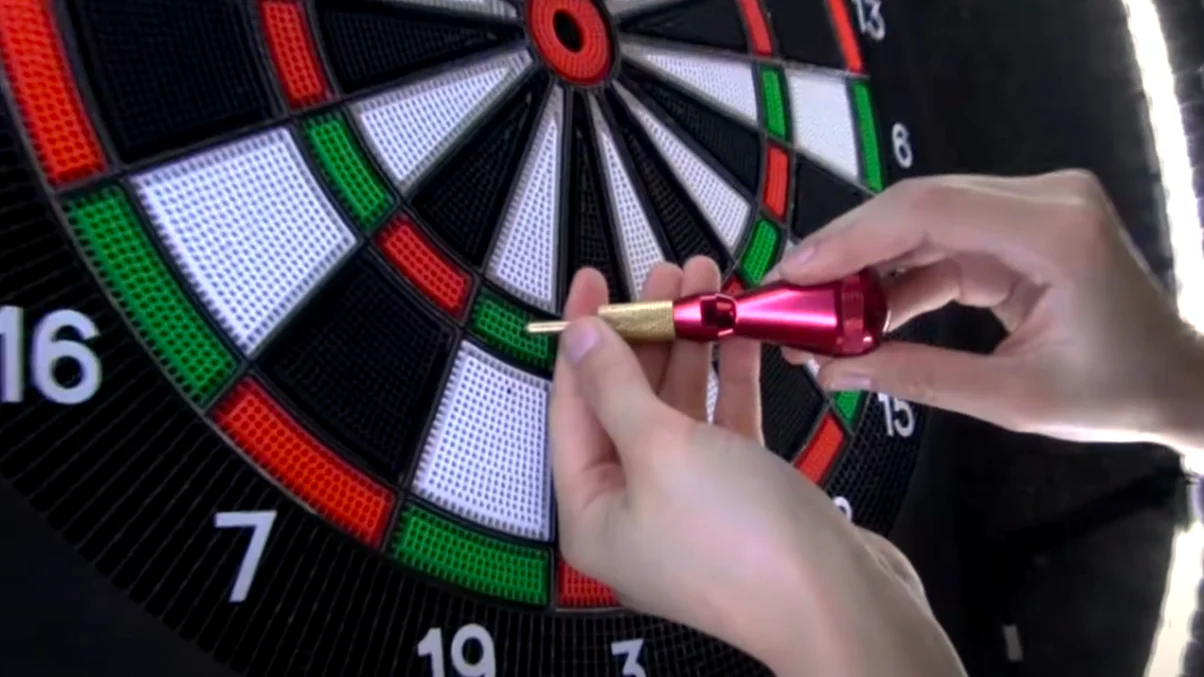
A soft tip dart rarely fails all at once. A tip blunts, a flight splits, a shaft works loose, and accuracy fades before the player can say why. Each fault costs a small part to fix; left together, they can cost the board.
Flights are usually the first part to go
A flight is a thin sheet of plastic or nylon under constant stress. Its job is to put drag at the rear of the dart so the point leads all the way to the board. Deflections off other darts bend it, and tight groupings risk a Robin Hood, where an incoming dart lands inside the shaft of the one before it and wrecks both.
The early signs are small: a nick on one edge, a fin starting to fray, fins that no longer open to a clean 90-degree angle when spread.
A flight sitting a few degrees off changes the drag at the rear, and the dart wobbles or fishtails in the air. Scores that hold up one night and scatter the next often trace back to a flight that looked fine at a glance.
Watch how the dart lands, too. A dart that sticks tail-down or sideways is flying badly at the rear, and the flight is usually the cause.
Flight protectors cap the rear of the flight and stop incoming darts from sliding into the shaft. They cost little and extend flight life, though they won’t rescue a flight that’s already split.
Pinch the flight flat and let go. If the fins don’t spring back square, it’s done.
Flights are the cheapest part of the dart and the one a regular player replaces most often. Keep a few spares in the case.
Shafts fail quietly
Nylon and polycarbonate shafts crack before they break. Look for hairline fractures near the threads and around the tines that grip the flight, especially after a drop onto a hard floor or a heavy deflection. A cracked shaft can give way mid-session.
The tines are another wear point. Those small prongs splay open over time, and a flight that keeps popping loose is usually pointing at tired tines rather than a bad flight.
Aluminum shafts don’t crack. They bend, and the bend is easy to miss by eye. Take the shaft off the dart and inspect it on its own for any bend. Aluminum won’t straighten reliably once it’s bent.
Nylon shafts cost less and flex on impact, which suits most home players. Aluminum costs more and holds the flight rigid, and that suits players who group tightly and want the rear of the dart locked in place.
Metal shafts threaded into metal barrels bring a second problem. Every dart landing in the board vibrates the connection, and the shaft slowly unscrews itself mid-match. Small rubber O-rings seat between shaft and barrel and hold it tight.
O-rings dry out and crack, and sometimes they go missing entirely. A shaft that works loose twice in a leg breaks a player’s rhythm at the worst moments. The fix costs almost nothing, and a few spare rings in the case prevent the problem.
A shaft that still rattles with a fresh ring has worn threads. Most modern soft tip shafts and tips use the standard 2BA thread, and years of tightening grind it down.
At that point the shaft needs replacing.
How to read a plastic tip
Plastic tips take the hit on every throw, and they wear in ways a player can read. A bent tip is easy to spot by rolling the dart between finger and thumb with the point resting on a table.
Mushrooming is subtler: the point flares wider than the hole it needs to enter, and the dart starts sitting proud of the segment. Whitening is the late warning. The plastic has gone brittle, and the snap usually comes mid-match.
Tips unscrew like shafts do, and a loose tip rattles in the barrel. Tighten it by hand before play. If it won’t hold, the threads are gone and the tip is due.
A bounce-out here and there happens to everyone. A run of them in one night points straight at the tips.
Replacement tips are sold in bags for a reason. A player who throws a few nights a week works through them steadily, and buying a handful at a time costs more per tip and leaves the case empty the night one snaps.
What worn tips do to the board
Behind the board’s segments sits a pressure-sensitive matrix that registers every hit. The holes in each segment are sized for a straight, clean tip. A mushroomed tip hits the face of the segment and rebounds, and a bent tip goes in at an angle and twists the plastic every time it’s pulled free.
The board is the most expensive part of the setup, and tips are what protect it. A blunt or broken tip driven into a segment can crack the plastic and damage the sensors underneath. Board repairs are expensive compared to a bag of replacement tips.
Players who throw regularly often replace the whole set once the tips start going, and it’s a sensible spend. When researching replacement darts for electronic dart board games, check that the set is compatible with the board in use before buying.
Check the board manual for the manufacturer’s dart weight limit. Darts above that limit can damage the segments, even if the tips are in good condition.
The barrel wears too slowly to notice
The barrel is the only part a player touches on every throw, and it wears the slowest. Knurling, ring cuts and pixel grips on brass or tungsten smooth down over months of skin oil and friction. The change is gradual enough that the player adapts without noticing.
Run a fingertip over the grip zone, then over the barrel near the point and the stem, where hands rarely go. A middle that feels slicker than the ends is a grip on its way out.
A worn grip doesn’t throw the dart off line by itself. It makes the release inconsistent, because the fingers slip a fraction differently on every throw. The player sees scatter across the board and blames technique.
Inconsistent release shows up as vertical scatter. The line stays true and the darts still land high and low of the mark.
Cleaning helps early. Warm soapy water and a soft brush lift the oil out of the cuts and bring some bite back.
Once the texture itself has worn flat, no cleaner restores it. Barrel wear is usually what ends a set, because few players strip a dart down and replace the body piece by piece.
Wear moves the balance point
A dart is balanced around a center of gravity when it’s made, and wear shifts that balance.
A worn tip has lost material at the front. A bent shaft moves mass off the dart’s line. A smoothed grip changes where the fingers sit, which changes the pivot of the throw.
This is why one new component can make a familiar dart feel strange. A heavier replacement tip pulls the balance forward. A longer shaft pushes it back. Matching spares to the dart’s original spec keeps the feel the player has practiced with.
A matched set makes this visible. If one dart of three carries a fresh tip and the other two carry worn ones, the three fly differently, and the player adjusts for equipment between throws.
When several parts wear at once, the dart in the hand is no longer the dart that was bought. Groupings drift, and no single swap brings them back. That’s usually the sign the set itself is due.
Repair or replace: match the spend to the player
The two options have different cost profiles. Consumables such as tips, flights, shafts and O-rings are small recurring spends that keep a sound set running. A new set is one larger spend that resets everything, barrel included.
Replace parts when the wear sits in the consumables and the barrel still grips. This favors the player with a settled throw who likes the weight and balance of the set in hand. The ongoing cost stays low, and the feel stays familiar.
Replace the set when the barrel has worn smooth, when the barrel threads are tired, or when the game has moved on. A player who has built a consistent throw often wants a different weight or grip shape than the set they learned on. That spend buys equipment matched to a better throw, and it favors the improving player.
The cheapest parts on the shelf aren’t always the saving they look like. Soft tips that bend in a week cost more across a season than durable ones, because the part that costs little gets bought often.
Keep track of what wears fastest. A player who replaces flights monthly and tips twice a year knows where the money goes, and stocks the case accordingly.
Sourcing is straightforward either way. Most modern soft tips and shafts share the 2BA thread, so components match across brands with a quick check of the listing. A specialist ecommerce store lays out tips, shafts and flights by size and material, and multi-packs cost less per piece and keep the spares kit full.
A two-minute check before a session
A short routine before play catches wear while it’s still cheap. Check each shaft on its own for a bend, and pinch each flight to watch it spring back.
Check every tip for whitening or a mushroomed point. Tighten each shaft and feel for rattle.
Anything that fails a check gets swapped from the spares kit on the spot. Anything that can’t be swapped, like a slick barrel or a tired thread, goes on the list for the next order.
