

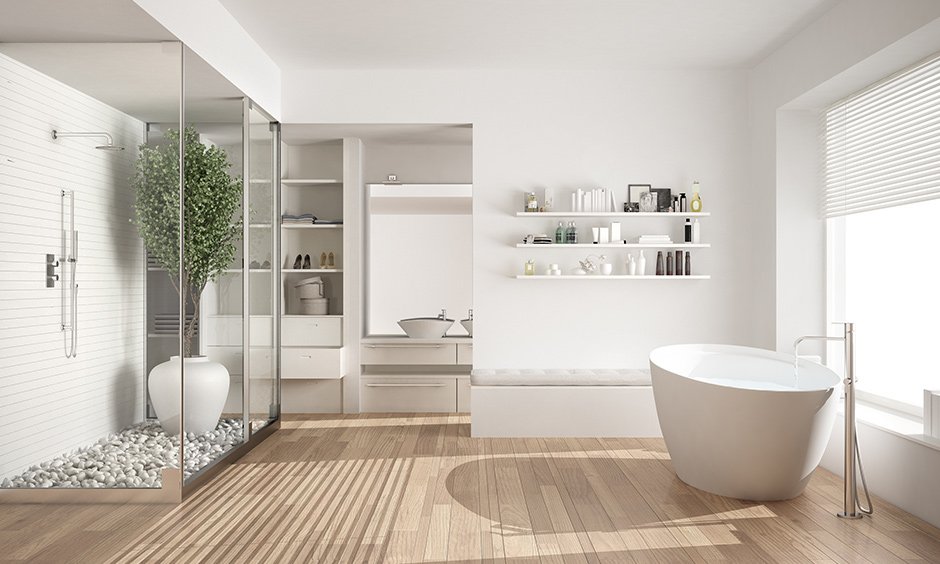
The master bathroom has quietly undergone the most significant architectural evolution of any room in the modern residence. What was once treated as a purely utilitarian enclave, governed by plumbing runs and clinical white surfaces, has shifted into a central sanctuary for daily restoration. Contemporary homeowners are no longer satisfied with standard suburban layouts that isolate the tub in an awkward corner and cram a prefabricated shower stall against a partition wall.
Instead, modern design treats the primary bath as an experiential continuum. It balances structural honesty, sensory warmth, and intuitive mechanics to create a space that feels grounded rather than showroom-sterile. Achieving this balance requires looking past surface trends and focusing on the relationship between spatial proportions, material integrity, and everyday human routines.
The Open-Concept Wet Room and Seamless Transitions
One of the most defining movements in modern residential architecture is the dissolution of unnecessary visual barriers. In the bathroom, this philosophy finds its clearest expression in the curbless wet room. By eliminating the traditional raised shower curb and running continuous flooring across the entire footprint, the room instantly reads as larger, more cohesive, and architecturally deliberate.
A successful wet room relies on precision engineering beneath the surface. Single-slope mortar beds paired with concealed linear wall drains allow large-format tiles or solid stone slabs to flow uninterrupted from the dry vanity area directly into the shower zone. This avoids the chaotic spiderweb of grout joints required by traditional center drains.
Frameless, ceiling-height glass panels—or strategically placed architectural baffle walls—contain water spray without breaking sightlines. Within this unified waterproof envelope, positioning a sculptural freestanding soaking tub directly beside or behind the showerhead creates an integrated hydrotherapy suite. This layout maximizes spatial efficiency, keeps water containment isolated to a single durable zone, and turns bathing into a deliberate ritual rather than an afterthought squeezed between closets.
Material Authenticity: Replacing the Sterile Palette
For years, contemporary design was mistakenly equated with monochrome chilliness: glossy white porcelain, mirror-finished chrome, and slick quartz that felt more like an operating room than a private retreat. Today’s design sensibilities lean heavily into tactile depth and earthy material balance.
Grounding the Space with Earthy Textures
Visual interest in a contemporary bathroom should come from subtle texture rather than noisy pattern. Incorporating hand-troweled lime plasters, such as water-resistant Moroccan tadelakt, gives shower walls a velvety, seamless finish that softly diffuses light.
Honed natural stones—such as limestone, travertine, or muted quartzite—replace polished finishes with a matte, touchable surface that patinas gracefully. Paired with ribbed or fluted white oak vanity fronts, these organic surfaces counteract the inherent hardness of tile and glass, introducing warmth, depth, and biophilic resonance to the interior.
Living Metals and Structural Accents
Plumbing fixtures act as the jewelry of the bathroom, but high-gloss chrome has largely stepped aside for metals with visual weight. Unlacquered brass, oil-rubbed bronze, and brushed nickel bring an understated architectural dignity to water controls.
Living finishes oxidize subtly over years of use, telling the story of the home rather than remaining perpetually reflective and cold. When set against minimalist wall-mounted spouts and concealed thermostatic valves, these metals bridge classical permanence with crisp, modern geometry.
Cantilevered Volumes and Integrated Sinks
The contemporary vanity is an exercise in structural lightness. Floor-bound cabinetry often visually swallows floor area, making even generous suites feel heavy. By contrast, a floating cantilevered vanity anchored securely to wall framing opens up the perimeter, allowing light and flooring to extend underneath.
Custom stone sinks integrated seamlessly into the countertop surface eliminate rim grime and create a singular monolithic block that reads as sculpture. If vessel basins are preferred, pairing low-profile concrete or carved basalt bowls with minimalist wall-mounted fixtures keeps counter surfaces clean and open for daily essentials. Under-cabinet channel lighting mounted beneath the vanity base casts a soft wash of light along the floorboards, making the heavy millwork appear almost weightless after dark.
The Layered Anatomy of Restorative Lighting
Few elements compromise a bathroom design faster than poor illumination. Relying solely on a grid of recessed ceiling downlights casts unflattering, harsh shadows across faces and strips natural materials of their warmth. A sophisticated contemporary bathroom relies on a tiered lighting strategy that adapts to different times of day.
Task lighting at the vanity should always be horizontal and diffused. Vertical sconces mounted at eye level on either side of the mirror—or soft, indirect perimeter illumination integrated directly into the mirror frame—provide even, shadow-free illumination across the face for grooming.
Ambient illumination is best achieved through concealed LED cove lighting tucked into ceiling reveals or beneath floating shelving. Installing warm-spectrum fixtures calibrated to simulate daylight during the morning and dim down to an amber glow in the evening supports natural circadian rhythms. A dedicated ultra-low-output pathway light, wired to a discreet motion sensor near the baseboards, provides just enough guidance for nighttime visits without shocking resting eyes.
Invisible Storage and Quiet Functionality
A serene aesthetic cannot survive functional chaos. Modern bathrooms demand rigorous storage solutions that tuck everyday toiletries, electrical cables, and personal care appliances entirely out of view.
Recessed medicine cabinets set flush with surrounding wall tile preserve clean sightlines while keeping grooming products accessible at eye level. Inside floating vanities, full-extension drawers notched around plumbing runs house integrated power outlets, allowing hairdryers, electric shavers, and toothbrushes to remain plugged in and operational while hidden away.
Tall floor-to-ceiling millwork towers framed into wall niches provide deep, linen-closet capacity without protruding into primary circulation paths. When storage is calculated around actual habits, surfaces remain naturally uncluttered, preserving the calm, contemplative atmosphere that defines contemporary architectural spaces.
Building a master bathroom that endures comes down to respecting how the human body moves through space and interacts with physical matter. By prioritizing curbless continuous surfaces, tactile natural materials, layered lighting, and concealed utilities, the contemporary master bath ceases to be a hurried morning stopover. It becomes what it was always meant to be: a quiet, restorative retreat that grounds the start and conclusion of every day.
